Featured Project: Emergency H2S & Volatile Organic Compounds (VOCs) Emission Control in West Coast Refinery Tank Degassing – SCAQMD Rule 1149 Compliance (2025 Case Study)
With South Coast AQMD’s ongoing enforcement of Rule 1149 amid 2025 Air Quality Management Plan (AQMP) updates—emphasizing enhanced monitoring for toxics like H2S and VOCs during tank degassing to meet federal NSPS and state ozone attainment goals—uncontrolled releases from crude oil tanks can escalate to public nuisance violations under Rule 402, with penalties scaling to $1,000,000 per day for egregious cases. Envent’s integrated scrubber-thermal oxidizer systems deliver >99% H2S removal and VOC destruction, ensuring zero NOVs while protecting communities from odor impacts.
The Challenge: High-H2S Crude Tank De-Inventory Triggers Multiple Odor Complaints
A major West Coast refinery needed to urgently de-inventory a large storage tank containing Arabian Crude Oil with unexpectedly elevated hydrogen sulfide (H2S) concentrations—exceeding 500 ppm, far above typical sour crude thresholds. This volatile HAP posed severe risks during degassing, as vapors escaped during roof landing and cleaning phases.
Critical Issues:
- Odor Nuisance: Internal refinery complaints escalated to a public report via AQMD’s 1-800-CUT-SMOG hotline, triggering an investigation under Rule 402 (Nuisance) and potential Rule 1149 violations for uncontrolled tank emissions. H2S’s characteristic “rotten egg” smell at low concentrations (0.03 ppm detectable) led to community health concerns, including respiratory irritation and nausea.
- Regulatory Stakes: Under SCAQMD Rule 1149 – Storage Tank and Pipeline Cleaning and Degassing, tanks >500 gallons with Reid Vapor Pressure (RVP) >0.5 psia require 95%+ VOC capture/destruction during degassing, plus toxics controls for HAPs like H2S and benzene. Non-compliance risks $1,000–$1,000,000 daily fines, escalating with odor validation or exceedances of 55 lbs/day VOC limits (§1149(b)). Historical refinery cases, like 1988 Santa Fe Springs incidents, saw $400,000+ penalties for similar sulfur releases.
- Operational Urgency: Delays could halt turnaround schedules, costing $50,000+/day in lost production amid 2025 Rule 1173(f) RECLAIM facility reporting deadlines.
Official SCAQMD Resources:
- Rule 1149: Storage Tank Cleaning and Degassing – Applicability, control efficiencies, and monitoring for VOCs/toxics.
- Odor Complaints & Rule 402 Enforcement – Reporting and public nuisance protocols.
Envent’s Integrated Solution: Dual Scrubbers + Thermal Oxidizer for H2S and VOC Destruction
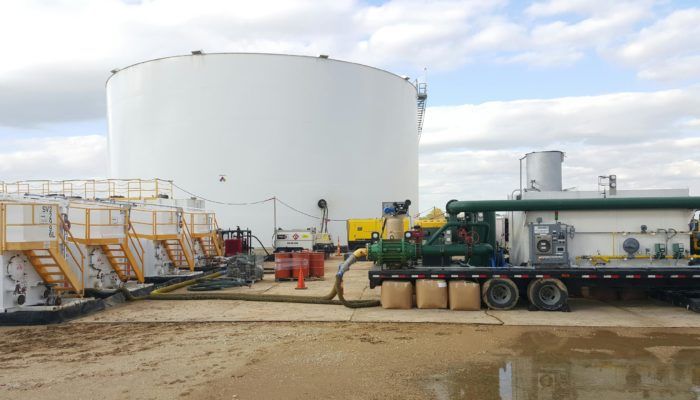
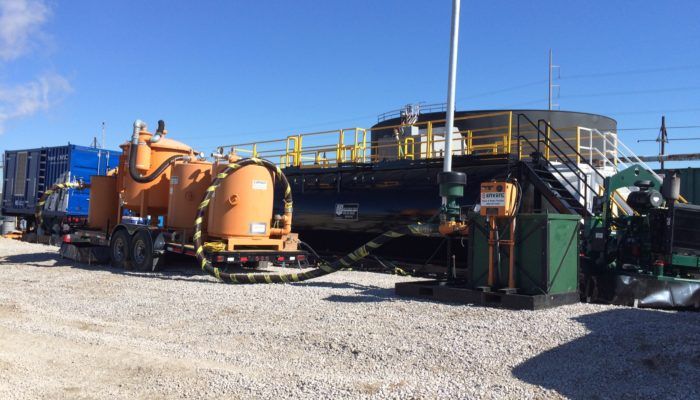
Envent mobilized within hours, deploying a turnkey vapor control train compliant with Rule 1149’s vapor recovery and destruction mandates. Vapors from the de-inventory process (up to 1,000 SCFM) were routed through:
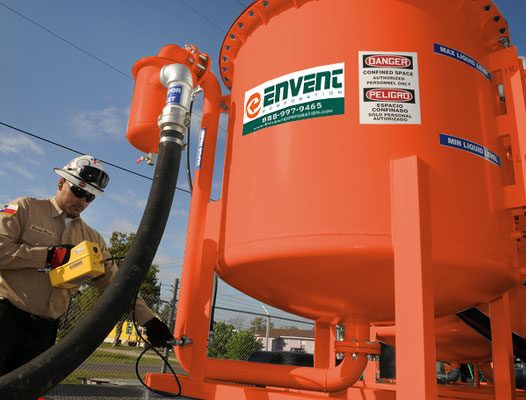
- Primary H2S Control: Two ESCRUB-1000 Recirculating Wet Scrubbers in Series: Each 1,000 SCFM unit uses Envent’s proprietary alkaline media (NaOH/caustic solution) to achieve >99% H2S removal efficiency, converting it to non-volatile sodium sulfide salts. This targeted wet scrubbing handles sour gas streams without clogging, maintaining pH 8–10 for optimal absorption per EPA Method 11 testing—critical for Arabian Crude’s high-sulfur profile (up to 2.5 wt% S). Treated air exits with <5 ppm H2S, eliminating odors and meeting Rule 1149 toxics narrative standards.
- Secondary VOC/HAP Destruction: EMTOS-3500 Mobile Thermal Oxidizer: Post-scrubbing off-gases enter the 3,500 scfm unit, preheated to 1,500°F+ for >99.9% thermal oxidation of remaining VOCs (e.g., BTEX), benzene, and trace HAPs. Auto-ignition and flame monitoring ensure safe combustion, with stack temperatures verified via continuous recorders per Rule 1149(d) for RECLAIM facilities. No auxiliary fuel exceeded 10% of total heat input, minimizing CO/NOx byproducts.
Full integration included temporary piping, blowers, and real-time sensors (H2S, VOC, flow) for Rule 1149-compliant reporting. Explore Envent’s wet scrubber rentals and thermal oxidizer fleet for similar setups. The system operated seamlessly until de-inventory completion, with zero emissions exceedances.
Proven Benefits: $100K+ Savings, Odor Elimination, and Rule 1149 Compliance
Envent’s swift response averted a regulatory nightmare, showcasing our expertise in SCAQMD-governed degassing:
| Benefit | Project Impact |
|---|---|
| Financial Savings | Immediate mobilization prevented shutdowns and fines, saving $100,000+ in potential penalties and downtime—far below Rule 1149 violation costs (e.g., $5,000–$50,000 per event baseline). |
| Odor & Emission Reductions | >99% H2S capture destroyed 200+ lbs of potential releases, resolving complaints and complying with Rule 402—no further AQMD investigations. |
| Regulatory Assurance | Full documentation for Title V/RECLAIM deviations avoided; systems met 95%+ control efficiency, aligning with 2025 AQMP toxics reductions. |
| Operational Efficiency | Scalable setup handled variable flows without interruptions, supporting refinery turnaround timelines. |
| Health & Community Protection | Eliminated H2S exposure risks (<10 ppm ambient post-treatment), enhancing public trust in line with SCAQMD’s community air monitoring initiatives. |
This project reinforces Envent’s dominance in SCAQMD Rule 1149 tank degassing, where rapid H2S/VOC controls prevent 2025 enforcement spikes.
Need H2S Controls for Your Next Degassing? Get a Free Rule 1149 Compliance Quote Contact Envent’s engineers at 888-997-9465 or email [email protected] for a no-obligation assessment. We’re ready 24/7—explore our emergency response services.