Every year, North American refineries, chemical plants, and fuel terminals conduct thousands of maintenance operations requiring the safe removal of hydrocarbon vapors from storage tanks, vessels, and pipelines. Simultaneously, environmental remediation contractors face the challenge of extracting volatile organic compounds (VOCs) from contaminated soil at former industrial sites, gas stations, and manufacturing facilities. Both scenarios demand specialized equipment and expertise in degassing and vapor extraction, critical services that protect worker safety, make sure regulatory compliance, and allow successful project completion.
This complete guide explores industrial degassing technologies, refinery turnaround applications, water treatment systems, and soil vapor extraction (SVE) processes, with specific focus on how Envent Corporation’s mobile fleet serves major markets across Texas, Louisiana, California, and throughout North America.
Understanding Industrial Degassing: From Tanks to Pipelines
Degassing is the controlled removal of hydrocarbon vapors, toxic gases, and other volatile substances from enclosed spaces before maintenance, inspection, or decommissioning activities. The process is essential for creating safe working conditions and meeting OSHA’s permit-required confined space entry standards (29 CFR 1910.146).
Why Tank Degassing is Critical for Industrial Safety
Before personnel can enter a storage tank, reactor vessel, or pipeline for inspection, repair, or cleaning, the atmosphere must be rendered safe through complete vapor removal. The hazards addressed by proper degassing include:
- Flammability Risk: Hydrocarbon vapors in concentrations between the Lower Explosive Limit (LEL) and Upper Explosive Limit (UEL) create explosive atmospheres. Gasoline vapors, for example, are flammable between 1.4% and 7.6% by volume in air
- Toxicity Hazard: Benzene, hydrogen sulfide (H₂S), and other compounds pose acute health risks even at low concentrations. OSHA’s Permissible Exposure Limit (PEL) for benzene is just 1 ppm as an 8-hour time-weighted average
- Oxygen Deficiency: Hydrocarbon vapors displace oxygen, creating asphyxiation hazards. OSHA requires atmospheric oxygen content between 19.5% and 23.5% for safe entry
- Environmental Compliance: Uncontrolled vapor releases during tank opening violate Clean Air Act regulations and trigger significant penalties. The EPA issued $3.2 million in fines in 2024-2025 for improper refinery tank degassing incidents.
The Industrial Degassing Process: Step-by-Step
Effective tank degassing follows a systematic approach designed to minimize emissions while achieving safe entry conditions:
- Step 1 – Product Removal: Drain liquid product to the maximum extent possible. Even small liquid heels generate significant vapor concentrations
- Step 2 – Initial Vapor Extraction: Connect a vacuum degasser or liquid ring blower to tank vents and begin vapor removal. This phase reduces hydrocarbon concentration from saturation (often 50,000+ ppm) to approximately 1,000-5,000 ppm
- Step 3 – Vapor Control: Route extracted vapors to emission control equipment, typically thermal oxidizers or vapor recovery units, to prevent atmospheric release. This step ensures EPA and state air quality permit compliance
- Step 4 – Air Dilution: Introduce fresh air while continuing vapor extraction to dilute remaining hydrocarbons. Modern degassing systems use forced air circulation with multiple air changes to accelerate the process
- Step 5 – Atmospheric Monitoring: Continuously measure oxygen content, LEL, and toxic gas concentrations using calibrated gas detection instruments. Entry is permitted only when readings meet OSHA standards: O₂ 19.5-23.5%, LEL < 10%, benzene < 1 ppm, H₂S < 10 ppm
- Step 6 – Final Certification: Conduct a complete atmospheric test and issue a confined space entry permit. Maintain continuous atmospheric monitoring and forced ventilation throughout the entry period
Types of Degassing Equipment: Vacuum Systems and Liquid Ring Technology
Vacuum Degasser Systems for High-Volume Vapor Extraction
A vacuum degasser uses mechanical blowers or liquid ring pumps to create negative pressure inside tanks and vessels, rapidly extracting vapor-laden atmospheres. These systems are essential for large storage tanks (> 100,000 barrels) and time-sensitive turnaround operations where rapid degassing is critical.
Liquid Ring Vacuum Degassers
Liquid ring technology dominates industrial degassing because of its ability to handle condensable vapors and entrained liquid droplets without damage. The operating principle involves:
- A rotating impeller creates a liquid ring (typically water or light oil) inside a cylindrical housing
- Vapor enters through the central inlet port and becomes trapped in pockets between the liquid ring and impeller vanes
- As the impeller rotates, these pockets are compressed and discharged through the outlet port
- The liquid ring simultaneously seals the compression chamber and absorbs heat from compression, keeping temperatures below hydrocarbon auto-ignition points
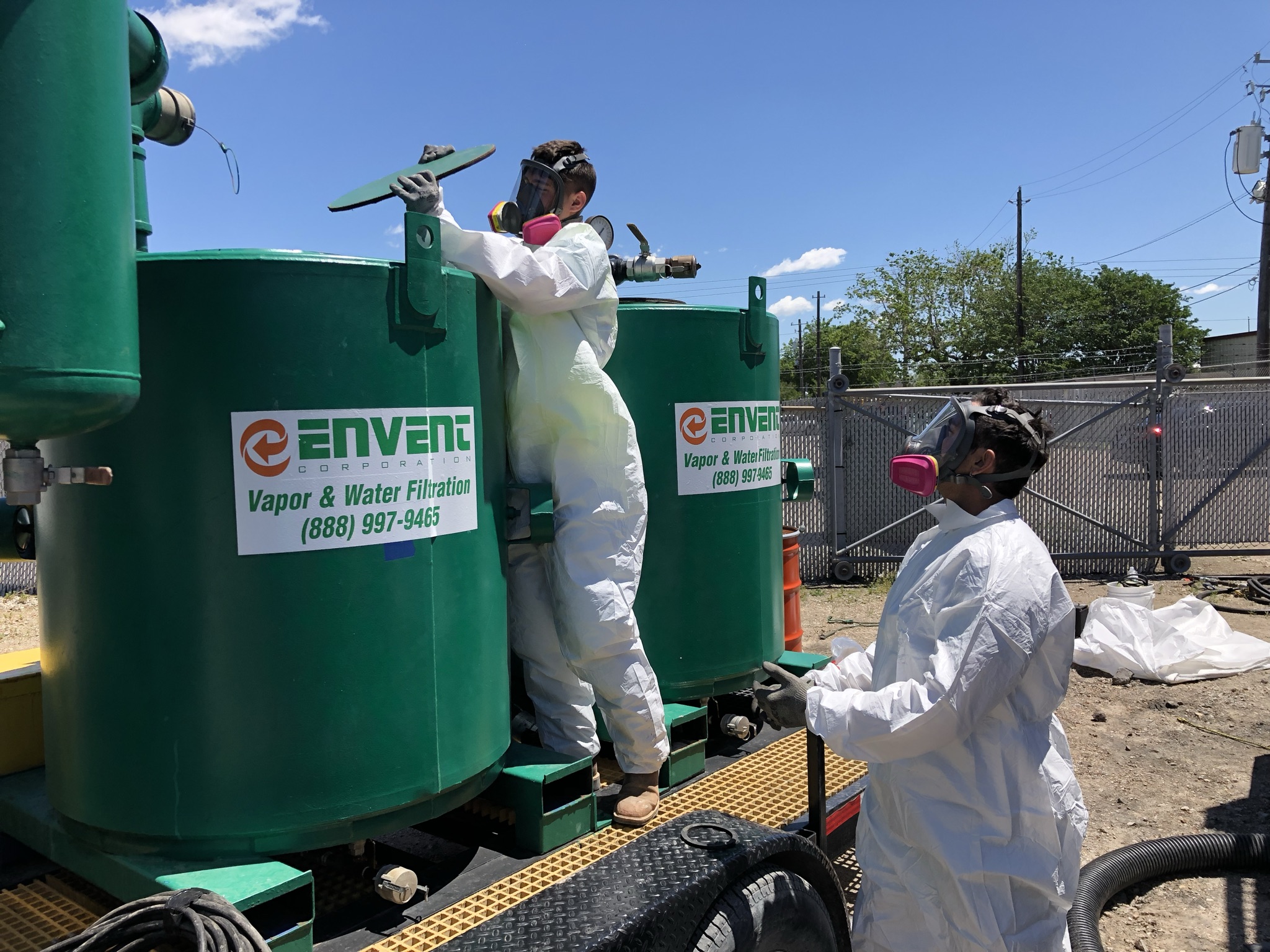
Envent operates liquid ring vacuum degassers ranging from 2,000 to 10,000 SCFM (standard cubic feet per minute) capacity. The largest units can degas a 500,000-barrel crude oil tank in 48-72 hours, a process that would take weeks using passive ventilation.
Rotary Blower Degassers
For applications not requiring deep vacuum (> 20 inches Hg) or handling wet vapors, rotary lobe blowers offer a cost-effective alternative. These positive displacement machines move high volumes of vapor at moderate pressure differentials, making them suitable for:
- Pipeline evacuation and purging
- Vessel vapor balancing during liquid transfers
- Final stages of tank degassing when vapor concentrations have been reduced below 1,000 ppm
Refinery Turnaround Degassing: Maximizing Safety and Minimizing Downtime
Planned refinery turnarounds, complete maintenance shutdowns occurring every 4-6 years, represent the most demanding degassing operations in the petrochemical industry. A typical Gulf Coast refinery turnaround involves:
- 20-40 major process vessels requiring degassing (reactors, fractionation towers, heat exchangers)
- 50-100 storage tanks needing safe entry preparation
- Miles of piping and process equipment containing residual hydrocarbons
- Total project costs of $50-200 million, where every day of delay costs $500,000-$2 million in lost production
Critical Path Degassing Operations
Efficient vessel degassing directly impacts turnaround critical path timelines. Consider a fluid catalytic cracking (FCC) unit turnaround:
- Day 1-2: Controlled shutdown, product draining, initial vapor extraction from reactor and regenerator
- Day 3-4: High-volume vacuum degassing to reduce hydrocarbon concentrations below 1,000 ppm. Envent typically deploys 3-5 liquid ring vacuum systems in parallel, processing 20,000-30,000 SCFM
- Day 5-6: Forced air circulation with continuous atmospheric monitoring. Target: O₂ > 19.5%, LEL < 5%
- Day 7: Final atmospheric testing, blind list confirmation, confined space entry permit issuance
- Day 8-30: Mechanical work proceeds (catalyst removal, internals inspection, refractory repair, etc.)
By reducing the degassing phase from 10-12 days (using conventional methods) to just 6-7 days with advanced vacuum degasser systems, refineries save $2-4 million in downtime costs.
Case Study: Sulfur Loading Vapor Control at Texas City Refinery
In 2025, Envent Corporation provided advanced vapor control solutions for a sulfur loading operation at a Texas City refinery, ensuring compliance with strict air quality standards and preventing H₂S emissions.
Project Highlights:
- Deployed wet scrubbing and activated carbon adsorption systems for H₂S removal.
- Tailored solutions to meet TCEQ and EPA BACT regulations.
- Overcame particulate fouling issues that caused H₂S spikes.
Results:
- Controlled H₂S emissions, meeting regulatory thresholds.
- Prevented odor complaints and environmental violations.
- Ensured smooth, uninterrupted refinery operations.
Degasser Water Treatment: Removing VOCs from Industrial Wastewater
Beyond tank and vessel degassing, liquid degasser technology plays a critical role in industrial water treatment. Common applications include:
Hydrotest Water Degassing and Treatment
When refineries and pipelines use water for hydrostatic pressure testing, the water becomes contaminated with residual hydrocarbons from pipe walls and equipment surfaces. Before discharge to wastewater treatment plants or surface waters, this water must undergo degassing water treatment to remove dissolved VOCs.
Vacuum Degassing Water systems work by:
- Pumping contaminated water through a vacuum tower or packed column
- Applying a vacuum (typically 24-28 inches Hg) to create a pressure differential that drives dissolved VOCs from the liquid phase to the vapor phase
- Routing extracted vapors to thermal oxidizers or vapor recovery systems
- Discharging treated water that meets all EPA and state water quality standards (typically < 10 ppm total hydrocarbons, < 1 ppb benzene)
A typical water degasser system can process 500-2,000 gallons per minute, achieving VOC removal efficiencies of 95-99%.
Advanced Waters Degasser Configurations
Modern waters degasser units employ sophisticated process controls:
- Multi-Stage Processing: Cascading vacuum chambers operating at progressively lower pressures (15, 20, 25 inches Hg) to maximize VOC stripping efficiency while minimizing energy consumption
- Online Monitoring: Continuous analyzers measuring inlet and outlet hydrocarbon concentrations, allowing real-time process optimization
- Chemical Enhancement: Addition of surfactants or defoaming agents to prevent foaming in the vacuum tower, which can severely reduce treatment efficiency
Regulatory Compliance: Navigating State and Federal Requirements
Federal Requirements: EPA and OSHA Standards
Degassing and SVE operations must comply with multiple federal regulations:
- Clean Air Act (CAA): VOC emissions from tanks, vessels, and SVE treatment systems must meet New Source Performance Standards (NSPS) or National Emission Standards for Hazardous Air Pollutants (NESHAP). Thermal oxidizers must achieve ≥ 95% destruction efficiency
- OSHA Confined Space Entry (29 CFR 1910.146): Requires atmospheric testing, continuous monitoring, and rescue equipment for all permit-required confined space entries. Degassing must reduce the atmosphere to < 10% LEL before entry
- RCRA Subtitle C: Tank and vessel cleaning may generate hazardous waste requiring manifesting and approved disposal. Proper characterization prevents costly violations
State Remediation Programs: Texas, Louisiana, California
Texas TRRP: Risk-based cleanup standards allowing site-specific remediation goals. The vapor intrusion pathway must be evaluated for all shallow contamination scenarios
Louisiana RECAP: Risk Evaluation/Corrective Action Program emphasizing rapid cleanup. SVE systems require LDEQ approval and quarterly progress reports
California ESLs: Environmental Screening Levels set ultra-conservative cleanup targets. Achieving regulatory closure often requires multiple lines of evidence, including soil vapor surveys, groundwater monitoring, and vapor intrusion assessment
Conclusion: Envent’s Complete Degassing and Vapor Extraction Expertise
From emergency refinery degassing operations in the Gulf Coast’s 24/7 industrial field to multi-year soil vapor extraction projects at California Superfund sites, Envent Corporation delivers proven expertise, cutting-edge technology, and unwavering commitment to safety and compliance.
Our Complete service portfolio spans:
- Industrial Degassing: Tank, vessel, and pipeline degassing using North America’s largest fleet of liquid ring vacuum systems
- Water Treatment: Advanced degasser water treatment for hydrotest water, contaminated groundwater, and process streams
- Environmental Remediation: Turn-key soil vapor extraction systems delivering regulatory closure at petroleum, solvent, and chemical-impacted sites
- Emission Control: Integrated thermal oxidation and scrubbing solutions ensuring 100% air quality permit compliance
Whether your project involves a critical-path refinery turnaround worth millions per day of delay, an emergency response to a contamination release, or a complex environmental cleanup requiring years of sustained operations, Envent’s experienced team stands ready to design, deploy, and execute the precise solution your situation demands.
Contact Envent for Degassing and SVE Solutions
Speak with our degassing and remediation specialists:
- 24-Hour Emergency Response: 888-997-9465
- Request a Quote: www.enventcorporation.com/request-a-quote
- Technical Inquiries: [email protected]
Serving refineries, chemical plants, fuel terminals, and environmental remediation contractors throughout Texas, Louisiana, California, and all of North America. Zero-incident safety culture, 30+ years of operational experience, 100% regulatory compliance guarantee.